Lesson
What Is Divine Revelation?
In one sentence
God, in His goodness and love, reveals Himself and His saving plan through words and deeds.
Why this matters
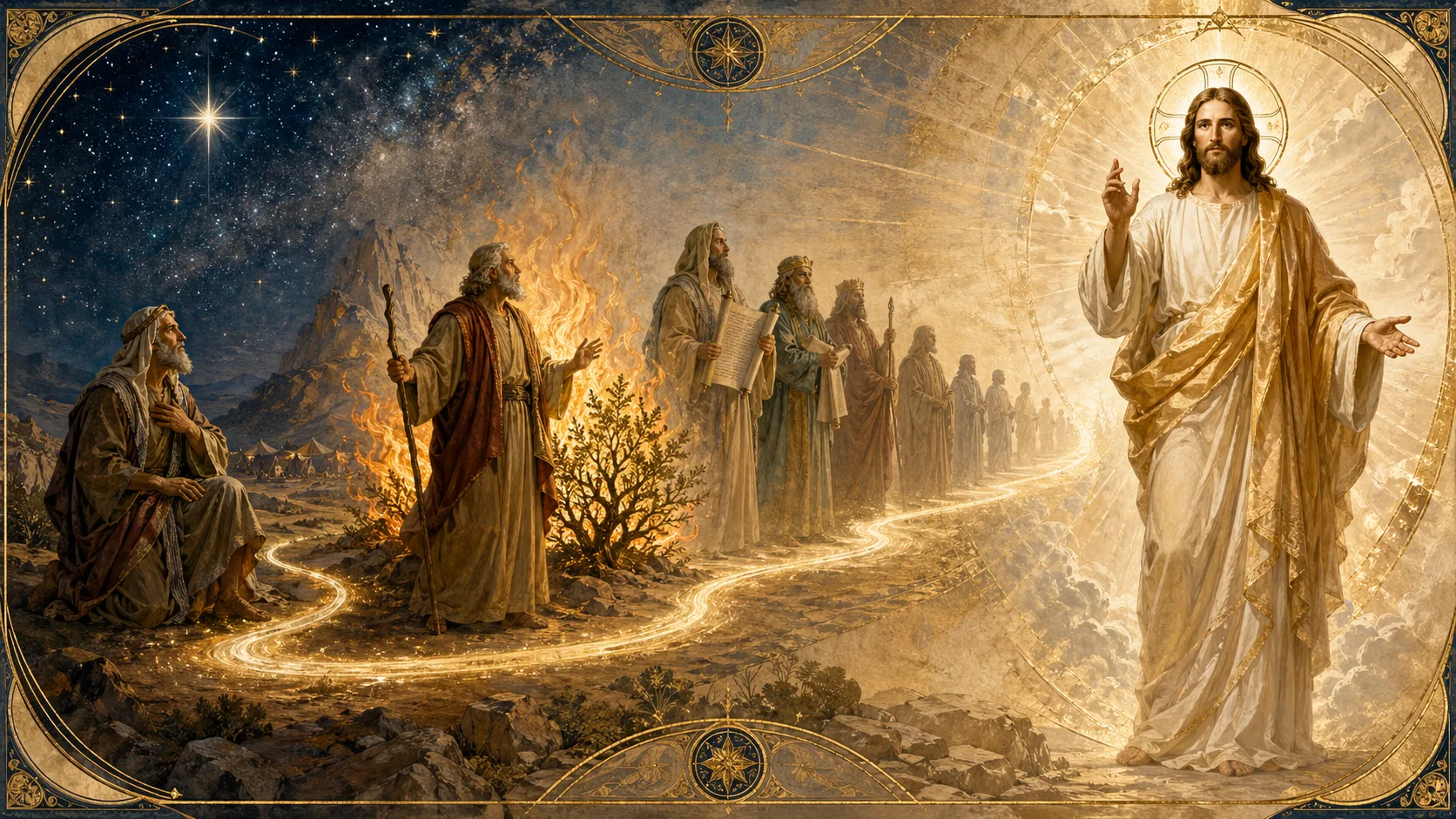
By the grace of the Holy Spirit, all people are to share in the divine life as adopted children in Jesus Christ. With the fall from grace of our first parents, Adam and Eve, sin and death entered into the world. God seeks to call us back to Him through His revelation unfolding throughout the ages, beginning with Abraham and culminating in Jesus Christ, the Word made flesh, in whom the fullness of God’s self-revelation is given.
Key Scripture
Genesis 12:1-3
1 Now the Lord said to Abram, “Go from your country and your kindred and your father’s house to the land that I will show you. 2 And I will make of you a great nation, and I will bless you, and make your name great, so that you will be a blessing. 3 I will bless those who bless you, and him who curses you I will curse; and by you all the families of the earth shall bless themselves.”
Exodus 3:13-15
13 Then Moses said to God, “If I come to the people of Israel and say to them, ‘The God of your fathers has sent me to you,’ and they ask me, ‘What is his name?’ what shall I say to them?” 14 God said to Moses, ‘I am who I am.’ And he said, “Say this to the people of Israel, ‘I am has sent me to you.’” 15 God also said to Moses, “Say this to the people of Israel, ‘The Lord, the God of your fathers, the God of Abraham, the God of Isaac, and the God of Jacob, has sent me to you’: this is my name for ever, and thus I am to be remembered throughout all generations.”
Hebrews 1:1-2
1 In many and various ways God spoke of old to our fathers by the prophets; 2 but in these last days he has spoken to us by a Son, whom he appointed the heir of all things, through whom also he created the world.
John 1:14
14 And the Word became flesh and dwelt among us, full of grace and truth; we have beheld his glory, glory as of the only Son from the Father.
Ephesians 1:9-10
9 For he has made known to us in all wisdom and insight the mystery of his will, according to his purpose which he set forth in Christ 10 as a plan for the fulness of time, to unite all things in him, things in heaven and things on earth.
2 Peter 1:3-4
3 His divine power has granted to us all things that pertain to life and godliness, through the knowledge of him who called us to his own glory and excellence, 4 by which he has granted to us his precious and very great promises, that through these you may escape from the corruption that is in the world because of passion, and become partakers of the divine nature.
Core teaching held in common
God truly reveals Himself to humanity. Divine revelation is not merely information about God, but God’s self-disclosure in His saving action and speech. This revelation unfolds gradually and in a partial way throughout the history of salvation, and is brought to its fullness and completion in Jesus Christ, the incarnate Word. Through Him, human beings come to know God, have access to the Father in the Holy Spirit, and are made able to share in the divine life. Both the Eastern Orthodox and Roman Catholic traditions affirm that God’s revelation is manifested through His deeds and words in history, received in the life of the Church, and faithfully handed on in Holy Scripture and Holy Tradition.
Early Church witness
Saint Justin Martyr testifies in Dialogue with Trypho:
There existed, long before this time, certain men more ancient than all those who are esteemed philosophers, both righteous and beloved by God, who spoke by the Divine Spirit, and foretold events which would take place, and which are now taking place. They are called prophets. These alone both saw and announced the truth to men, neither reverencing nor fearing any man, not influenced by a desire for glory, but speaking those things alone which they saw and which they heard, being filled with the Holy Spirit. Their writings are still extant, and he who has read them is very much helped in his knowledge of the beginning and end of things, and of those matters which the philosopher ought to know, provided he has believed them.
Saint Irenaeus teaches in Against Heresies:
This, therefore, was the [object of the] long-suffering of God, that man, passing through all things, and acquiring the knowledge of moral discipline, then attaining to the resurrection from the dead, and learning by experience what is the source of his deliverance, may always live in a state of gratitude to the Lord, having obtained from Him the gift of incorruptibility, that he might love Him the more; ‘for he to whom more is forgiven, loves more’: and that he may know himself, how mortal and weak he is; while he also understands respecting God, that He is immortal and powerful to such a degree as to confer immortality upon what is mortal, and eternity upon what is temporal; and may understand also the other attributes of God displayed towards himself, by means of which being instructed he may think of God in accordance with the divine greatness. For the glory of man [is] God, but [His] works [are the glory] of God; and the receptacle of all His wisdom and power [is] man. Just as the physician is proved by his patients, so is God also revealed through men. … [being] the Word of God who dwelt in man, and became the Son of man, that He might accustom man to receive God, and God to dwell in man, according to the good pleasure of the Father."
Terms to know
Divine Revelation
God’s self-disclosure of Himself and His will to humanity through His deeds and words in the history of salvation, fully revealed in Jesus Christ.
Sacred Scripture
The divinely inspired Word of God written by human authors under the guidance of the Holy Spirit.
Sacred Tradition
The living transmission of divine revelation in the life of the Church, beginning with the apostles and continuing through their successors.
Deposit of Faith
The apostolic faith entrusted by Christ to the apostles and preserved in the Church through Sacred Scripture and Sacred Tradition.
As Vincent of Lérins explains:
What is “The Deposit?” That which has been entrusted to thee, not that which thou hast thyself devised: a matter not of wit, but of learning; not of private adoption, but of public tradition; a matter brought to thee, not put forth by thee, wherein thou oughtest to be not an author but a keeper, not a leader but a follower.
Incarnation
The mystery by which the Son of God became man in Jesus Christ.
Salvation history
The unfolding of God’s saving work in time, from creation through the covenants, culminating in Christ and continuing in the life of the Church.
Common misunderstandings
Revelation is not merely religious information about God.
Divine revelation is not merely information about God. It includes God’s words, but it is first His self-disclosure, His actions and speech in the history of salvation, fulfilled in Jesus Christ. God did not communicate His word in a mechanical or uniform manner. Rather, He spoke through human authors in ways that reflect their distinct styles, cultures, and literary forms. Some wrote history. Some wrote poetry. Others wrote instruction, prophecy, or song. These writings together form Sacred Scripture, the inspired witness to God’s revelation.
Revelation is not private opinion or subjective spiritual feeling.
Divine revelation is not merely a private religious opinion, personal intuition, or subjective spiritual feeling. It is God’s real self-disclosure in history, fulfilled in Jesus Christ, witnessed in Sacred Scripture and Sacred Tradition, and received in the life of the Church.
Revelation is complete in Christ.
Divine revelation reaches its fullness in Jesus Christ. There is no new public revelation after Him, because God has fully spoken in His Son. The Church grows in understanding of this revelation over time, but does not receive new revelation beyond Christ.
Sacred Tradition is not merely human custom.
So then, brethren, stand firm and hold to the traditions which you were taught by us, either by word of mouth or by letter. 2 Thessalonians 2:15
Sacred Tradition must not be confused with mere human custom. It is not the same thing as local habits, cultural preferences, veiling, beards, ethnic expressions, or pious practices that may vary from place to place. These lesser traditions may be beautiful and spiritually useful, and often deeply rooted in the identity of a given parish, but Sacred Tradition is something deeper: the living transmission of the apostolic faith in the Church.
St. Paul commands the Thessalonians to hold fast to what they received, whether “by word of mouth or by letter.” The apostolic faith was not delivered as Scripture detached from the life of the Church, but as the saving truth of Christ preached, worshiped, confessed, guarded, and handed down. The New Testament was not yet fully written, gathered, and recognized as a completed canon while the apostles were first spreading Christianity. The Scriptures to the apostles were the Old Testament. The early Church lived from the apostolic preaching, worship, sacramental life, and teaching that would later be witnessed in the New Testament writings. Scripture and Tradition are therefore not rivals, but inseparable witnesses to the one faith once delivered to the saints.
This is why Christianity cannot be reduced to sincere individuals gathering privately and deciding, on their own authority, what the Word of God means. To study Scripture is good and necessary, but Scripture was received, preserved, canonized, and proclaimed within the Church. Sacred Tradition is the Church’s faithful handing-on of God’s revelation in Christ, so that every generation may receive not private opinion, but the saving truth of God Himself.
Sacred Scripture and Sacred Tradition should not be treated as enemies. Revelation is fulfilled in Christ and is not replaced by later speculation.